Describe one work of art in detail
How it changes the abilities of the body
What does this mean ethically
In this lecture, we have watched four art examples of technologised body, they are from Eric Siu' Touchy, Stelarc, Stahl Stenslie and Kazuhiko Hachiya respectively.
This time, I would like to pick one of the four examples to express my feeling on this topic, the one I picked is from Kazuhiko Hachiya.
The art protect I watched in the lecture is called "Inter Discommunication Machine" which was made in 1993. In that machine, each of two visitors wearing a visor transimitting a real-time image of the other person's visual field. Kazuhiko Hachiuya won the prizes about this artwork at Artec 95,Nagoyia, Japan and Ars Electrionica, Linz, Austria 1996.
The visor is composed of a video camera, transmiters, head mounted displays, batteries, and feather. As mentioned, the machine projects the other vision and sound of the other one's display, it aims to confusing the individual identity of the two "players". Therefore, when the players wearing the helmet, it takes several seconds to let them realize where and who they are, in the process of the " game", they have to find back their body via the vision of another player.
I think the concept of the artwork is bottom-up. On the first level, it is just a game about the exchange of vision and hearing, to the children, it may be just like Hide and Seek. On the second level, it is a game of questioning vision and our individual perception of the world. It is a question of Who am I and how the other see me physically and how you see yourself mentally. As in this fast lane life, it takes no time for people to do self-reflection, and this art work is an alarm calling people to make it,to think about their identities.
Video from Youtube ;https://www.youtube.com/watch?v=JOzVzcmK0VU
Mission to Earth is a new form of filmmaking method which is called digital cinema or database cinema.
One of the difference between digital cinema and traditional filming making is the later one is defined as a fixed and linear narrative structure. However, in the digital cinema, the story is developed by selecting scenes from a software. The software controls the layout,the numbers of window and the content of the film.
For the traditional filming making, the story is clear because it is easy to let the audience know the content of the story. When we talk about Mission to Earth, the story and the images shown on the screen seems have relationship, but it is not. In the story, the voice over is telling a story, but the images shown is another things, therefore, the audience seem watching a liner story.
Thus, a digital cinema is a video about the intersection of software culture, cinema and architecture.
Besides, this film like the early film, it contains short clip of the reality (a recording of the reality);
this film like a digital art, it contains lots of media art, the use of pixels, softwares to create an illusion;
this like a painting, we can the artwork at different angles, and have different kinds of feelings//.
If you ask someone, who has not watched any of database movies, to describe what database cinema is, he may tell you something like the normal cinema movies we watched, however, it is totally another stuff. Only those who experienced that genre of "database movie" could tell what it is!
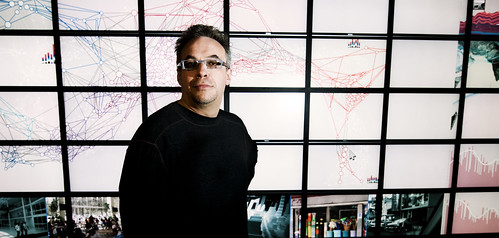
Lev Manovich- Maker of Mission to Earth From: http://farm4.static.flickr.com/3464/3181056839_5f933ed738.jpg
Picture captured from Mission to Earth From http://www.softcinema.net/scrnshts/alpha-1.jpg
Describe in detail the role of Youtube in facilitating one or two recent pro-democracy movements. Drawing on your reading, discuss the ways in which Youtube facilitated to those movements Youtube: YouTube is a video-sharing website headquartered in San Bruno, California. The service was created by three former PayPal employees in February 2005 and has been owned by Google since late 2006. The site allows users to upload, view, and share videos, and it makes use of Adobe Flash Video and HTML5 technology to display a wide variety of user-generated and corporate media video. Available content includes video clips, TV clips, music videos, and other content such as video blogging, short original videos, and educational videos.
Egyptian Tank Man incident: On a side street leading into
Tahrir Square
Who: Mass civilian movement; strikes by labour unions
Demands: Democratic elections, resignation of
President Hosni Mubarak after 30 years of rule; end
of police brutality, end of state of emergency
Civilian casualties: At least 800 deaths; others suffered
police brutality or torture; some females were
subjected to "virginity tests."
b) A detailed description
of the work
·shows a protester courageously single-handedly standing down Egyptian riot police and water cannons (at approximately 1:25), in a Tiananmen Square-like moment. The video was shot by a balcony overlooking a large street protesters and bystanders are clearly overheard shouting in Egyptian Arabic in the background.
· Many media and people take this video as the moment in Tiananmen Square Beijing. They compared the difference of the society background, the reason for the revolution...The spread of this video provokes much more attention to the Arab Spring/ Egyptian Revolution outside the Arab world.
· We use Facebook to schedule the protest, use Twitter to coordinate and Youtube to tell the truth (Abbassi, Jawad, CEO Arab Advisors Group. “An Overview of the Arab Telecom and Broadband Markets and Broadcast Media Industry.” Georgetown University
for Contemporary Arab Studies Symposium. “Information Evolution in the
Arab World.” 22 March, 2010. Accessed 10 November, 2011.) “The revolution has no leader, I said. It was more like a raging wild horse that would buck anyone who tried to mount it against its will.” ― Wael Ghonim, Revolution 2:0: A Memoir and Call to Action “Ideas spread more rapidly in densely connected social networks. So tools that increase the density of social connection are instrumental to the changes that spread. […] And, more importantly, increased density of information flow (the number of times that people hear things) and of the emotional density (as individuals experience others’ perceptions about events, or ‘social contextualization’) leads to an increased likelihood of radicalization: when people decide to join the revolution instead of watching it." Stowe Boyd
c)An
evaluation of the work in terms of yourspecific research question The Egyptian tank man is just an example of how Youtube as a platform, to facilitate the progress of the Egyptian revolution. For the other pro-democracy movement, there are many different vids on Youtube showing how the citizens there are suffering under the dictatorship and the repression in their life. Reference : Hopkins, Jim (October 11, 2006). "Surprise! There's a third YouTube co-founder". USA Today. Retrieved November 29, 2008. "Egypt activists plan biggest protest yet on Friday". Al Arabiya. 27 January 2011. Archived from the original on 1 February 2011. Retrieved 29 January 2011.